Best Small Bluetooth SpeakerLoudest Portable Bluetooth Speakers: How Loud Is Loud Enough?
Loudest Portable Bluetooth Speakers: How Loud Is Loud Enough?
The short answer
A loud portable Bluetooth speaker is one that stays clear and controlled at high volume in your setting. Manufacturers quote wattage or peak decibels, but these numbers are not measured the same way across brands, so they are weak comparisons. For a park or picnic, a compact speaker usually fills a small group well. For a large open space or a crowd, you need a bigger model.
If you have ever bought a speaker that looked strong on the box and then sounded thin the moment you turned it up, you are not alone. Most of us just want something we can carry to the park, the beach or a trip and hear clearly without wrestling with cables.
This guide is based on published specifications, vendors' own claims (which we attribute as such) and what buyers commonly report, since the author has not tested these speakers personally. Along the way we use findings from hands-on reviews by other people, always credited to them.
How loudness is measured and claimed: why the numbers on the box disagree.
Whether a compact speaker fills your space: park, picnic, beach or a larger crowd.
What "loud" really means: clean volume versus volume that distorts.
Bass that holds up: the difference between real low end and a boosted tone.
Whether the price matches the performance: known brands versus cheaper options.
How Loudness Is Measured and Claimed
Loudness on a spec sheet looks precise, but the numbers are easy to misread. A little background helps.
A decibel (dB) is a unit that measures how loud a sound is, compared to a reference level. The scale is logarithmic, so every 10 dB increase sounds roughly twice as loud to most people, while the sound pressure is actually about ten times greater. That means a speaker rated at 90 dB is not just a little louder than one rated at 85 dB. It is noticeably more powerful.
Wattage is the number most boxes lead with, and it tells you less than you might think. Watts describe how much electrical power the amplifier can draw. How much of that becomes sound depends on the drivers, the cabinet and the design. Two speakers with the same wattage can sound very different in volume.
Brands also quote two kinds of output, and the gap between them matters:
- Peak output: the maximum the speaker can hit for a very short burst.
- Continuous (RMS) output: the level it can hold over time without distorting.
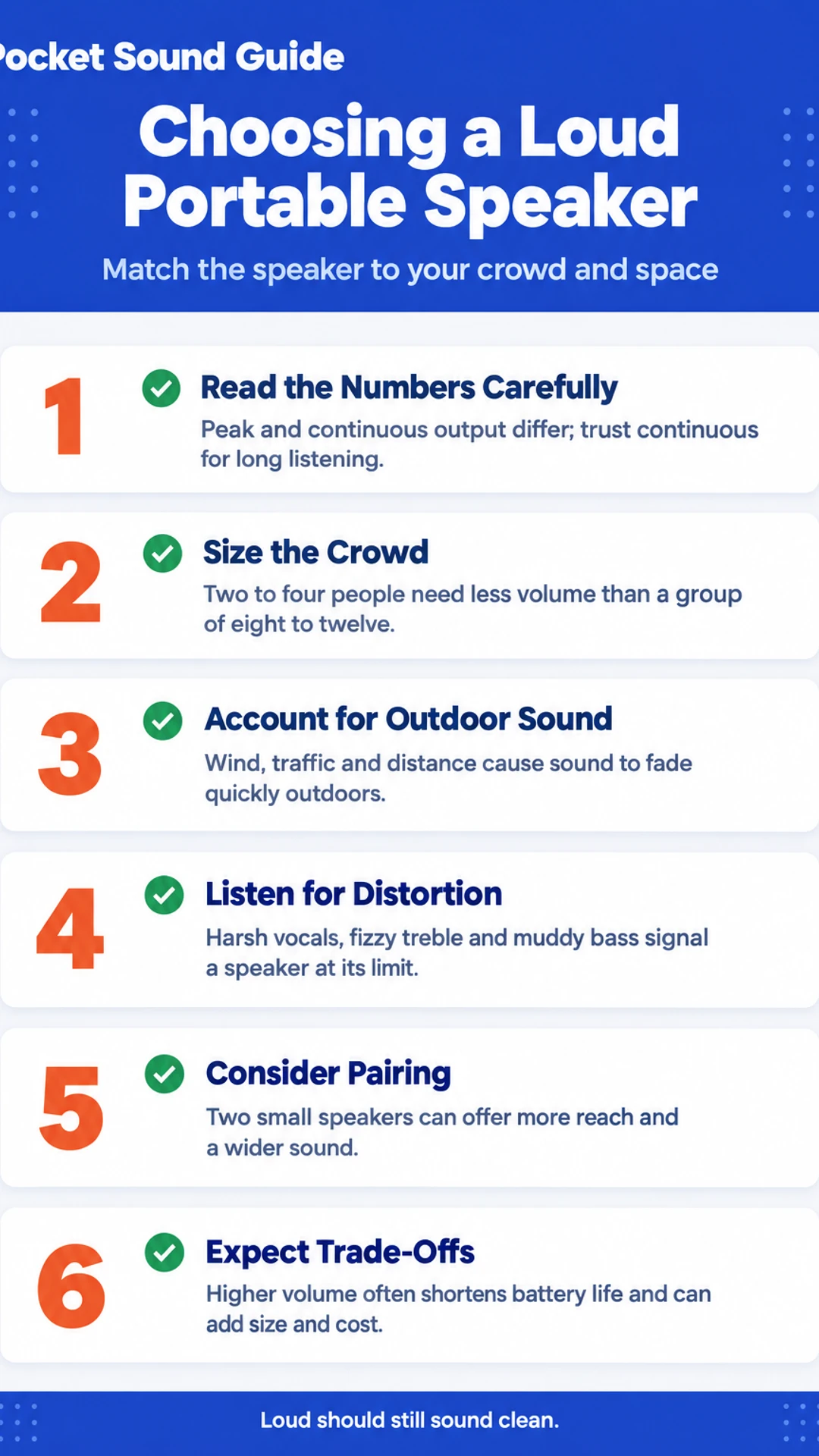
Peak figures are always higher. If you plan to play music at a party for an hour, the continuous number is the one to trust.
When you compare claims, keep a few rules in mind:
- Check whether a figure is peak or continuous, and whether the brand says which.
- Look for a decibel rating measured at a stated distance, not just a bold headline number.
- Read published reviews that measure volume directly. In one Rossen Reports test, the reviewer's meter reached 90 dB on a JBL Flip 5, which gives you a real benchmark.
Peak versus continuous output
| Output type | What it means | When to trust it |
|---|---|---|
| Peak output | Maximum for a very short burst | Not for long listening |
| Continuous (RMS) output | Level held over time without distorting | Parties and long sessions |
How Loud Is Loud Enough for Your Situation
Start with the crowd, not the speaker. A few people sitting close together on a blanket need far less volume than most product pages suggest. For two to four people at a picnic table, a modest speaker is usually plenty. For a group of eight to twelve spread over a picnic blanket, you will want something noticeably louder. A larger gathering, or a party where people are dancing and talking over the music, is a different job entirely, and a small speaker will struggle.
Outdoors, sound dies faster than you expect. Wind carries sound away and can drown out quiet speakers. Traffic and nearby voices raise the background noise you have to beat. Water, like a beach or a lake, does not absorb sound much, but the open space means it spreads thin quickly. Distance matters most of all: doubling how far away a listener sits can cut the sound they hear by a large amount.
Why does a speaker that sounds fine indoors feel quiet outside? Indoors, walls bounce sound back at you and make things seem fuller. Outside there is nothing to do that, so the same speaker sounds thinner. Turn it up and check it in the actual spot before you decide it is enough.
Do you need a bigger speaker or two small ones? Often, two small speakers paired together give you more reach and a wider sound than one larger unit, and they are easier to carry. Many current models support pairing, so check that your chosen model does, and that your phone can connect to both. This is a practical choice many buyers make when they want more volume without a heavy bag.
Loudest Small Speakers Reviewers Have Tested
Loud is a relative word. A speaker that fills a kitchen may not fill a park, and a speaker that rocks a picnic table may not hold up on a windy beach. So it helps to look at what reviewers actually measured and heard, not just the number on the box.
Here are a few small models that reviewers have described as loud, with the findings attributed to the people who tested them.
- Ultimate Ears Mini Roll. In Danny Pops' comparison, this model puts out quite a bit of volume, and he also praised its build quality.
- JBL Flip 5. In Rossen Reports' test, it reached 90 on the decibel meter, with bass strong enough to vibrate.
- Soundcore Boom 3i. In Smart Home Sounds' review, it gets very loud and has more headroom than you might expect. When both it and the JBL Flip 7 were pushed hard, though, the Boom 3i lost control sooner.
- Beats Pill. In Smart Home Sounds' review, it does not go loud enough for a portable speaker of this type.
Notice that the JBL Flip 5 and Soundcore Boom 3i are both loud, but they fall apart at different points. Reviewers' readings are a starting point. Before you buy, check whether a model is loud enough for your group size and the space you plan to use it in. Watch for distortion at high volume, since a speaker that is loud but harsh gets tiring fast.
Reviewed small speakers and where they struggled
| Speaker | Reviewer finding | Reviewer |
|---|---|---|
| Ultimate Ears Mini Roll | Quite a bit of volume; praised build | Danny Pops |
| JBL Flip 5 | Reached 90 dB; bass vibrates | Rossen Reports |
| Soundcore Boom 3i | Loud; lost control sooner than JBL Flip 7 | Smart Home Sounds |
| Beats Pill | Not loud enough for this type | Smart Home Sounds |
Loud Versus Good: Distortion, Bass and Control at High Volume
A speaker can be loud and still be unpleasant. Once you push a small speaker close to its limit, the sound often starts to break down before the volume stops rising. Vocals get harsh, cymbals turn into a hiss, and the whole mix sounds like it is straining. That strain is distortion, and it is the reason a loud number on the box does not tell you much on its own.
What does distortion sound like as you turn it up?
- Vocals and guitars take on a rasp or buzz.
- Treble gets sharp or fizzy.
- Bass rumbles without really landing, or the whole sound gets congested.
- The speaker sounds like it is working harder, even though the music has not changed.
Boosted bass is a common trap. Many small speakers push the low end up so it impresses on a quick listen. At high volume, that extra bass can turn thin or muddy, because the driver cannot move enough air cleanly. You lose the punch you were paying for.
In Smart Home Sounds' review, the Bose SoundLink Flex 2 stays composed when turned up, with controlled bass that does not smear the rest of the sound. That is the kind of result you want to look for when you shop for a loudest bluetooth speaker.
The Sony Altfield One is a useful example of how a setting changes the trade-off. Smart Home Sounds found that its Alt mode gives punchier sound, while turning it off gives a more balanced, tighter listen. Neither is wrong. It depends on whether you want impact or clarity.
So when you compare a loudest bluetooth speakers model, ask yourself one question: does it still sound clean when you turn it up for a park, a beach or a group? Volume you can actually enjoy is the number that matters.
Trade-Offs of a Loud Small Speaker
Loudness is not free. Every bit of volume you add costs something, and the cost shows up in battery life, size, durability and price.
Does loud mean shorter battery life?
Yes, usually. An amplifier working hard at high volume uses far more power than one sitting at a comfortable level. So the runtime printed on the box is often measured at moderate volume. Before you buy, look for real-use tests that run the speaker loud, not just the spec sheet. In Danny Pops' comparison, the Marshall Willen 2 ran for 10 hours, while the Bose Micro 2 managed 6 hours. Those are his results, and conditions vary, but the gap is worth noticing.
Why does a bigger sound make the speaker bigger?
Louder sound needs larger drivers and a more powerful amplifier. Both add weight and size. A speaker that fills a picnic blanket usually cannot also slip into a jacket pocket. If you want both, expect to compromise somewhere.
Does a higher price mean a louder speaker?
Not reliably. In Rossen Reports' test, the $24 Soundcore Select 4GO was hard to tell apart from the $40 JBL Go4 on sound. Price reflects brand, build and features as much as volume, so compare test results rather than the price tag.
- Check runtime at high volume, not only the box claim.
- Expect bigger, louder speakers to be heavier.
- Do not assume a higher price means more volume.
- Test the speaker at the level you plan to use it.
How to Check Volume Before You Buy
Box claims about loudness are hard to compare. Brands rarely say how they measured it, so a "90 dB" figure from one company may not mean the same as one from another. You can get a useful answer yourself with a few simple checks.
Listen in a shop, but listen properly.
- Pick a track you know well, with clear vocals and some bass. Use the same song for every speaker you compare.
- Turn the volume up near the top of its range, not just halfway.
- Listen for distortion: harshness on vocals, a buzzing or rattling sound on the bass, or the sound going thin and fuzzy. A speaker that stays clean when loud is the one you want.
Check the return policy. Ask whether you can return the speaker if it disappoints. If you can, test it outdoors or in a room about the size of where you plan to use it. A small speaker that fills a bedroom may struggle on a windy picnic lawn, and a park is a different test from a kitchen.
Look for reviews that include decibel readings and say how they tested. Good reviews name the distance, the room or outdoor setting, and the volume level used. A reviewer who says "very loud" without numbers or conditions gives you little to go on. In Rossen Reports' comparison, the reviewer measured the JBL Flip 5 at 90 on a decibel meter, which is more useful than a general impression.
Check the specs against independent results. Compare the listed figures with named, published test results before you commit. If a brand's number is far above what independent reviewers record, trust the reviewers.
What hands-on reviewers found
These are other people's hands-on tests, summarised and credited to them. Watch the full videos for their complete reviews.
Smart Home Sounds: Portable Speaker Showdown: Which Should You Buy!? (2026)
The reviewer names the Marshall Emberton 3 as their personal favourite for sound and design, while concluding there is no single best speaker: the Bose suits all-round balance, the JBL and Soundcore suit loud, lively listening, and the Sono
- Reviewer finds the Bose SoundLink Flex 2 warm and rich with controlled bass, more low-end range than expected for its size, and stays composed when turned up. (at 3:16)
- Reviewer prefers the Marshall Emberton 3 for rock: its true stereo design fills the room, vocals are crisp, and the bass is clean and tight, though not the bassiest speaker. (at 4:20)
- Reviewer says the JBL Flip 7 sounds more complete than before, with better extension at both ends, but still slightly harsh and wanting more bass punch. (at 5:25)
Danny Pops: I Compared 10 Mini Bluetooth Speakers to Find the BEST!
Danny Pops concludes that the Tribit Stormbox Micro 2 and Ultimate Ears Mini Roll are the best-sounding speakers in the group, with the Tribit the better buy for the price, while the SoundCore Select 4 Go is the best budget option.
- The Marshall Willen 2 has the most battery power of the group at 10 hours, and its top buttons and joystick-style control are easy and intuitive to use. (at 0:33)
- The Bose Micro 2 has the least battery power at 6 hours and uses an older Bluetooth format and micro USB connector, which the reviewer expects to fail. (at 2:35)
- The SoundCore Select 4 Go costs about 25 to 30 dollars, is fully waterproof, and sounds about as good as the pricier speakers, though its sound is less sophisticated. (at 2:46)
Frequently asked questions
Is the JBL Partybox 1000 loud?
Yes. The JBL Partybox 1000 is a large party speaker, not a pocket model, and it is one of the louder units in JBL's range. It is built to fill a big room or an outdoor party area. It is heavy and needs mains power, so it suits a fixed spot rather than a park walk or a bag.
Which Bluetooth speaker is considered the best by RTINGS?
RTINGS tests and rates speakers on a fixed set of measurements, and its top-ranked model changes as new products are tested. Check the current RTINGS portable speaker ranking for the latest pick. Keep in mind that a top lab score does not always match what you want for your own use, such as weight, battery or water resistance.
Is a 700W speaker loud?
A high wattage number tells you the amplifier's maximum power, not how loud the speaker actually plays. Speakers with large power ratings are usually party or home units, and they are heavy. Loudness depends on the driver size, the cabinet and the efficiency. For a small carry speaker, a wattage figure in the tens is typical, so a 700W label is a marketing number to read with care.
Is a 120 decibel speaker loud?
120 decibels is about the level of a jet taking off nearby, and it can cause hearing damage quickly. Few small speakers reach it, and a sound level that high is not something you want. Most people listen somewhere between 70 and 85 decibels, which is loud enough for a group outdoors. A claimed peak figure says little about how the speaker sounds at a comfortable volume.
How loud is loud enough for a small Bluetooth speaker?
For a picnic or a small group in a park, a compact speaker with good output is usually enough. A quiet, open space with a few people near you is fine at moderate volume. For a crowded beach or a large lawn party, a bigger speaker will fill the space better. Test a speaker at the volume you actually plan to use.